
Q: How does the repertoire reflect the themes of International Women’s Day?
AA: The original basis of this concert was to highlight female conductors in Durham, so IWD is showcased a lot through that by itself, but Becca Vaughan-Williams (Footnotes Musical Director) and I have worked hard to choose repertoire that is written by women, or at the very least, is about women. Specifically, I have chosen a few pieces that showcase upper voice barbershop, a subgenre that is often overlooked. Some of Becca's pieces are contemporary works of the sacred choral repertoire; a field that is infamously dominated by men, so the fact that there is so much choral music of ancient texts that are here set by women is something of a particular note. As for BCO, for the past few years, every new work they have ever commissioned has been by a woman, with West's piece specifically being about a woman too. Hector's set works to highlight ancient repertoire that has been written for women, with women at the forefront performing each piece.
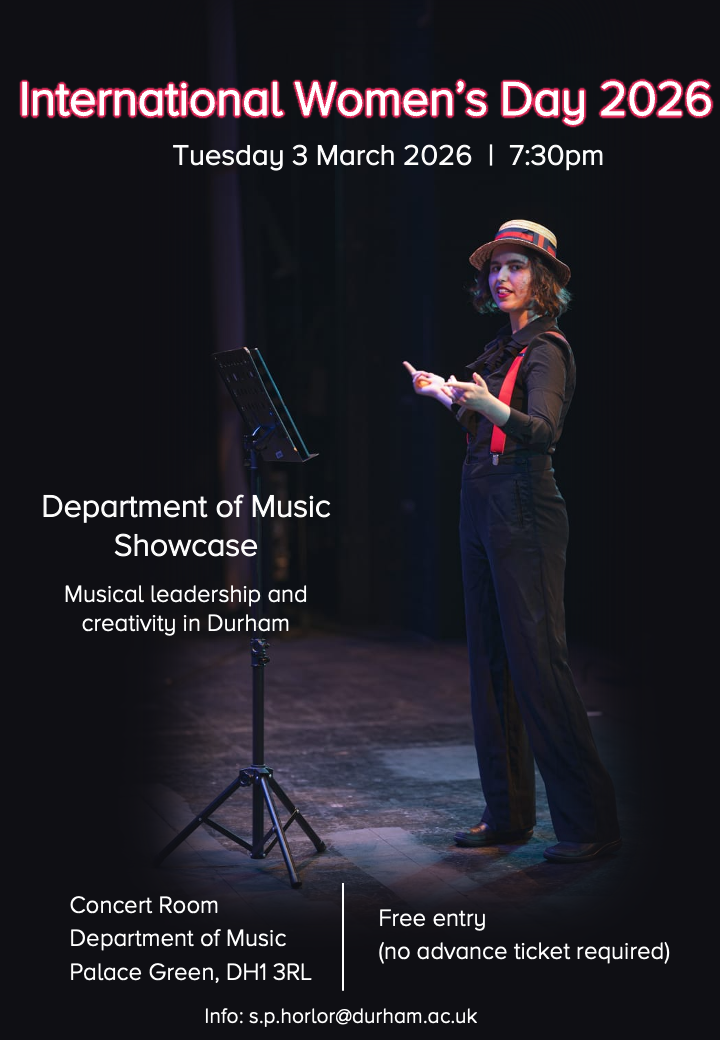
International Women’s Day Concert 2026
Ahead of the International Women’s Day Concert, DSM Outreach Officer Olivia McClintock spoke to Dr Sam Horlor and Amelia Awan, organisers of this year’s International Women’s Day concert, to find out more!
Q: Can you talk more about the groups performing in the concert and what makes each of them unique?
AA: Full Score, the choir which I direct, is one of the only student barbershop choirs in the country, and we work hard to preserve a style that is relatively unknown, especially in this country. In addition, we have a very high percentage of women and nonbinary people in our choir, to say our choral tradition is so heavily dominated by men. By contrast, Foot Notes has the most diverse array of repertoire of any a cappella choir here, and I have seen them excel in every genre they pursue, from Bach to Beyonce. The Bailey Chamber Orchestra is one of the most welcoming environments in Durham, and one thing I really admire about Philip (the orchestra’s conductor) is his ability to take care and get to know individual members of his orchestra on a personal level, working with them to create a musical environment that they want to be a part of.
Q: How can music contribute to conversations about international women’s day and women’s achievements?
AA: Women are so often forgotten about when talking about music, or treated as secondary. It is truly a scary world to go into, as a woman wanting to pursue what has historically been a male dominated field. It seems like every day there is a new story out there about how audition panels only hire musicians when they hear them perform behind a screen with a carpeted floor, how yet another famous cathedral has finally accepted female choral scholars after 900 years of not doing that, how people still refer to female composers by their full names, as if they were the exception. Maybe one day, there will be a world in which women are treated equally in musical spaces. But until then, we need to keep having deeper discussions, we need to keep having these conversations, and we need to celebrate the few women who are in music.
Q: Favourite rehearsal moment or story leading up to this event?
AA: Honestly, I have thoroughly enjoyed every part of this process, especially getting to know Sam better! But one that stands out to me was in a Full Score rehearsal, when we were looking at Astonishing (our piece for SSAA choir) and it all just seemed to come together on the final run-through. I've asked my musicians to take on a big challenge, but they have really risen to it.